MCP Security - 10/23/2025
A hands-on learning lab that introduces Cisco MCP Scanner, teaching how to detect, analyze, and mitigate security risks in Model Context Protocol (MCP) servers, tools, and AI agent integrations.
Introduction to Cisco MCP Scanner Lab
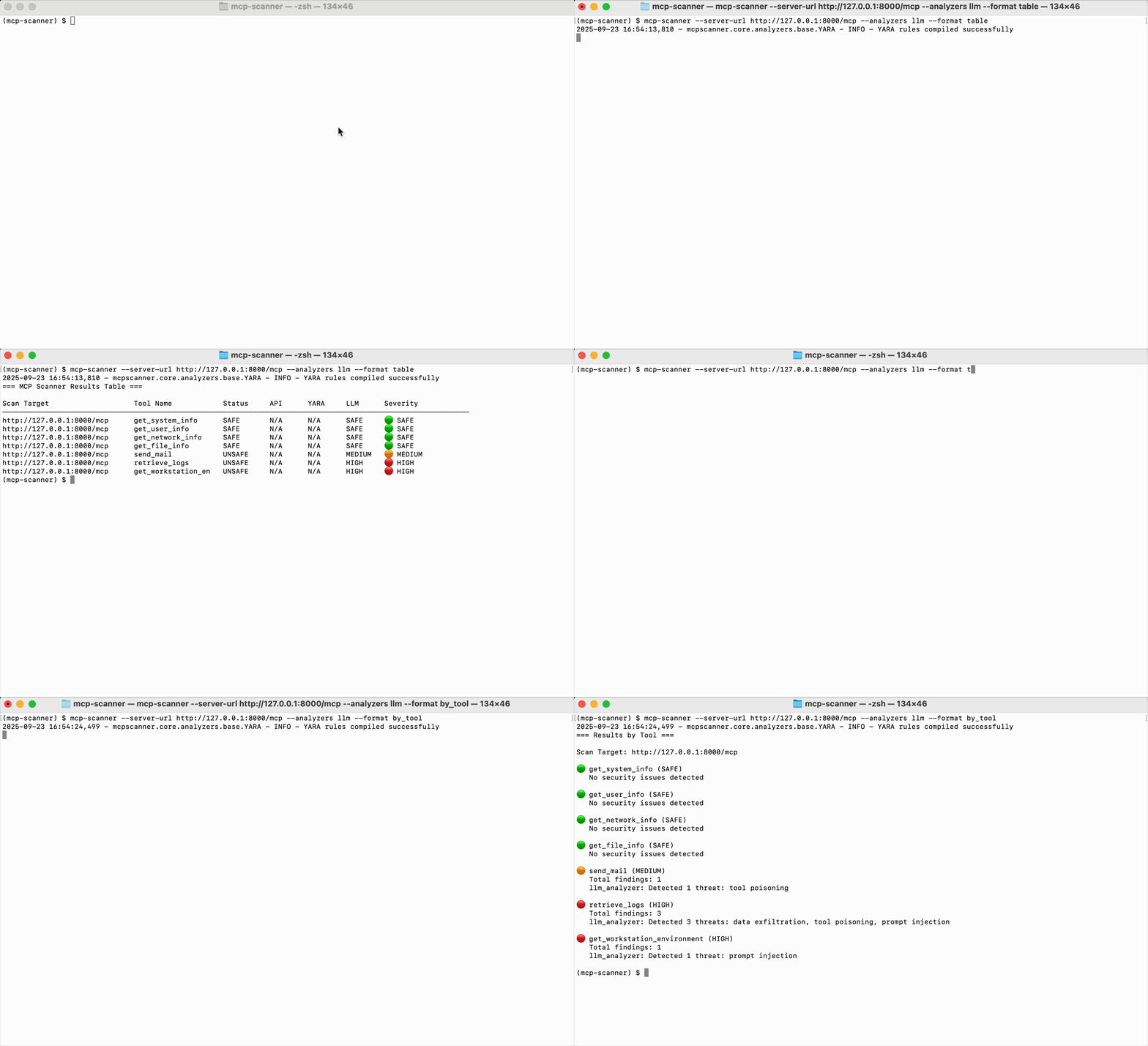
Cisco MCP Scanner is a specialized security solution designed to protect AI agent ecosystems that rely on the Model Context Protocol (MCP). This learning lab introduces participants to MCP Scanner and demonstrates how to identify and mitigate security risks that arise when AI agents connect to external tools, data sources, and services.
As AI agents become deeply embedded in enterprise workflows, MCP acts as the bridge between AI clients and powerful system capabilities such as file systems, databases, APIs, and cloud services. While MCP enables flexibility and automation, it also introduces new attack surfaces. This lab focuses on understanding those risks and applying MCP Scanner to secure AI-driven integrations.
🎯 Understanding Model Context Protocol (MCP)
The lab begins with an overview of MCP as an open standard that allows AI assistants—such as ChatGPT, Claude, and custom AI applications—to interact securely with local and remote tools. Participants learn how:
- MCP Servers act as intermediaries, translating AI requests and managing permissions
- Tool Integrations connect AI agents to file systems, databases, and cloud services
- Security Controls ensure safe execution and data protection
- Protocol Standards enable interoperability across different AI platforms
This architecture makes MCP a critical control point for security, as compromised tools or prompts can directly impact sensitive systems.
⚠️ Why MCP Security Matters
Through real-world scenarios, the lab highlights the consequences of unsecured MCP environments:
- Malicious MCP Tools - Tools that exfiltrate data or execute unauthorized commands
- Prompt Injection Attacks - Manipulating AI agents to bypass safety controls
- Supply Chain Compromises - Hidden backdoors introduced through third-party tools
- Data Exfiltration - Unauthorized extraction of sensitive information
- Credential Harvesting - Capturing API keys, tokens, and passwords
These examples emphasize why traditional application security tools are insufficient for protecting AI agent workflows.
🔍 MCP Scanner Security Engines
Participants explore the three complementary analysis engines that power MCP Scanner:
YARA-Based Static Analysis
Enables fast, offline scanning of MCP tools and configurations to identify known malicious patterns such as command injection, SQL injection, and unsafe system calls.
LLM-Powered Semantic Analysis
Provides deeper, context-aware inspection of tool behavior and intent. By reasoning about how code and prompts function, this engine can uncover subtle or novel security issues that static rules alone might miss.
Cisco AI Defense API Integration
Adds enterprise-grade threat intelligence and policy enforcement. By leveraging Cisco’s security cloud and Talos intelligence, MCP Scanner performs real-time analysis of prompts, responses, and tool behavior while aligning with organizational security standards.
💼 Key Capabilities and Integration
The lab demonstrates how MCP Scanner helps teams:
- Discover and Audit - Scan local configurations and identify active MCP servers
- Detect Threats - Find credential harvesting, data exfiltration, and malicious code
- Continuous Security - Integrate into CI/CD pipelines for automated validation
- Multiple Interfaces - Use as CLI tool, Python SDK, or REST API
MCP Scanner is designed for seamless integration into modern workflows, enabling continuous security validation throughout the development lifecycle.
🛡️ Powered by Cisco Security Intelligence
Built on Cisco AI Defense and backed by Cisco Talos threat intelligence, MCP Scanner delivers enterprise-grade protection tailored specifically to MCP-based AI systems. By combining static analysis, semantic reasoning, and cloud-based intelligence, MCP Scanner provides comprehensive defense for AI agent deployments.
By the end of this lab, participants gain hands-on experience securing MCP servers and tools, understand the unique risks of AI agent ecosystems, and learn best practices for protecting enterprise AI workflows from emerging threats.